![[Translate to EN:] Banner Stiftung](/fileadmin/_processed_/b/c/csm_banner-stiftung_fee6c1c492.jpg)
Background: Rising Pressure on Uzbekistan’s Ecosystems
Uzbekistan is currently experiencing rapid economic growth, which also comes with divers threats to ecosystems and species. Since reptiles and amphibians are highly specialized and due to their relative site dependancy often restricted to specific (micro-)habitats. Thus, they are among the first species groups to suffer from environmental change and change of habitat vitality. For example, the habitats of two newly discovered gecko species with the support of Michael Succow Foundation project are still not protected.
A New Concept: Key Herpetological Areas (KHA)
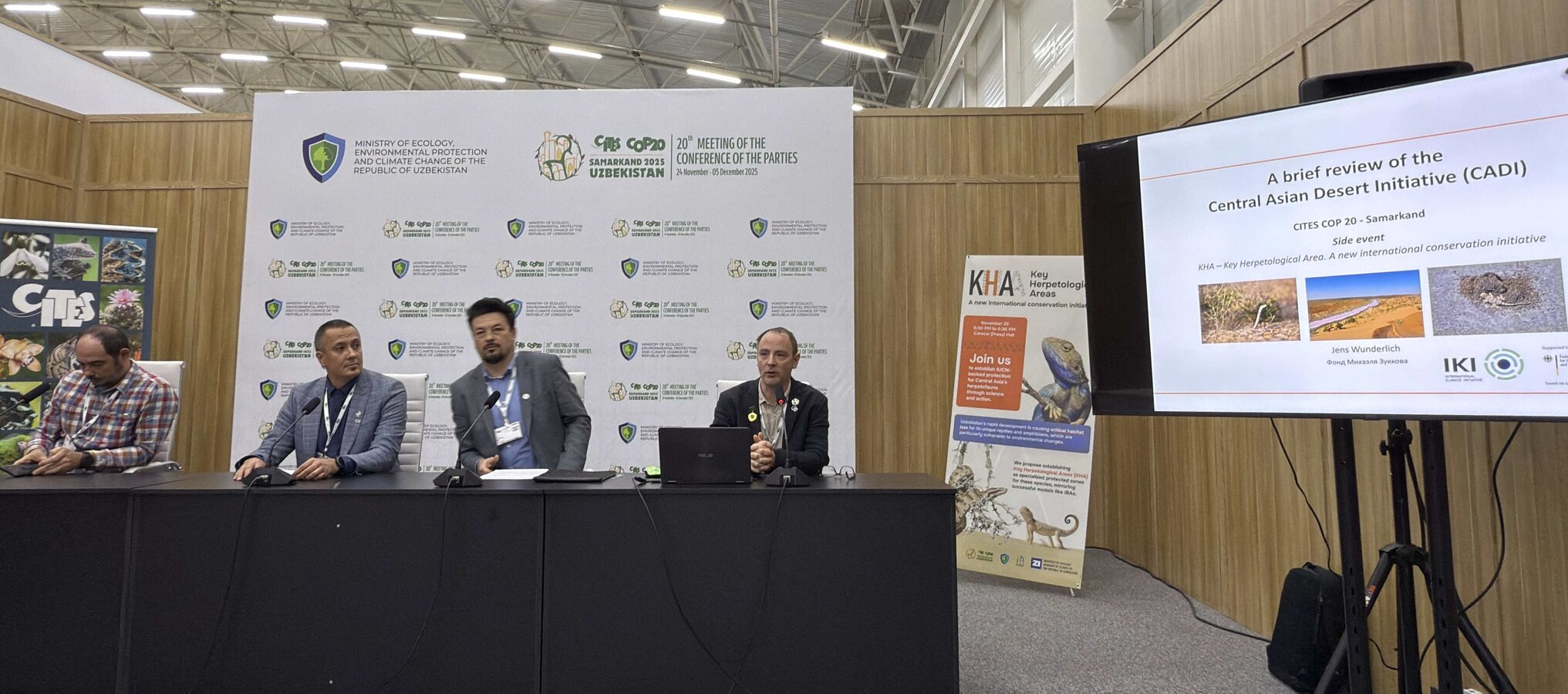
To address these challenges, researchers from the Institute of Zoology of Uzbekistan, in cooperation with IUCN and other international partners, proposed the establishment of Key Herpetological Areas. Modeled after existing successful frameworks such as Important Bird Areas (IBA) and Important Plant Areas (IPA), KHAs will identify and highlight natural sites with high concentrations of rare, endemic, or vulnerable reptile and amphibian species, with tailored threshold values and conservation indicators. These areas, though not staffed protected sites, serve as internationally recognized conservation priorities and can help guide national and regional environmental planning.
Insights from COP20: Central Asian Expertise Highlighted
During the side event, the Michael Succow Foundation presented on their specific experiences in conservation efforts and coorperation in multi-stakeholder environments in Central Asia and with focus at cold winter deserts — an ecosystem particularly relevant for Central Asian herpetofauna. Additional inputs addressed global and regional threats to reptiles and amphibians as well as the proposed criteria for establishing KHAs. The session concluded with a panel discussion and the formulation of preliminary recommendations for advancing the initiative within larger international conservation frameworks such as IUCN.
Strengthening Global Attention for Herpetofauna
The Michael Succow Foundation is delighted to support such global pioneering efforts originiated by Central Asian conservation stakeholders to strengthen global attention on herpetofauna and to promote effective conservation solutions for Central Asia’s unique and fragile ecosystems.